Stocklots vs Liquidation Apparel Explained
If you buy fashion inventory for margin and turnover, the difference between stocklots vs liquidation apparel is not just terminology. It affects product condition, brand mix, resale speed, claim risk, and how confidently you can price goods in your own market. Buyers who treat these channels as interchangeable usually feel the gap later, when assortments arrive, labels are inconsistent, or the sell-through does not match the original plan.
For professional buyers, both models can work. The better choice depends on what kind of business you run, how much control you need over product selection, and how much sorting risk your operation can absorb. A discount retailer with a flexible floor can work very differently from an e-commerce reseller that needs cleaner assortments, clearer branding, and faster listing turnover.
Stocklots vs liquidation apparel: the core difference
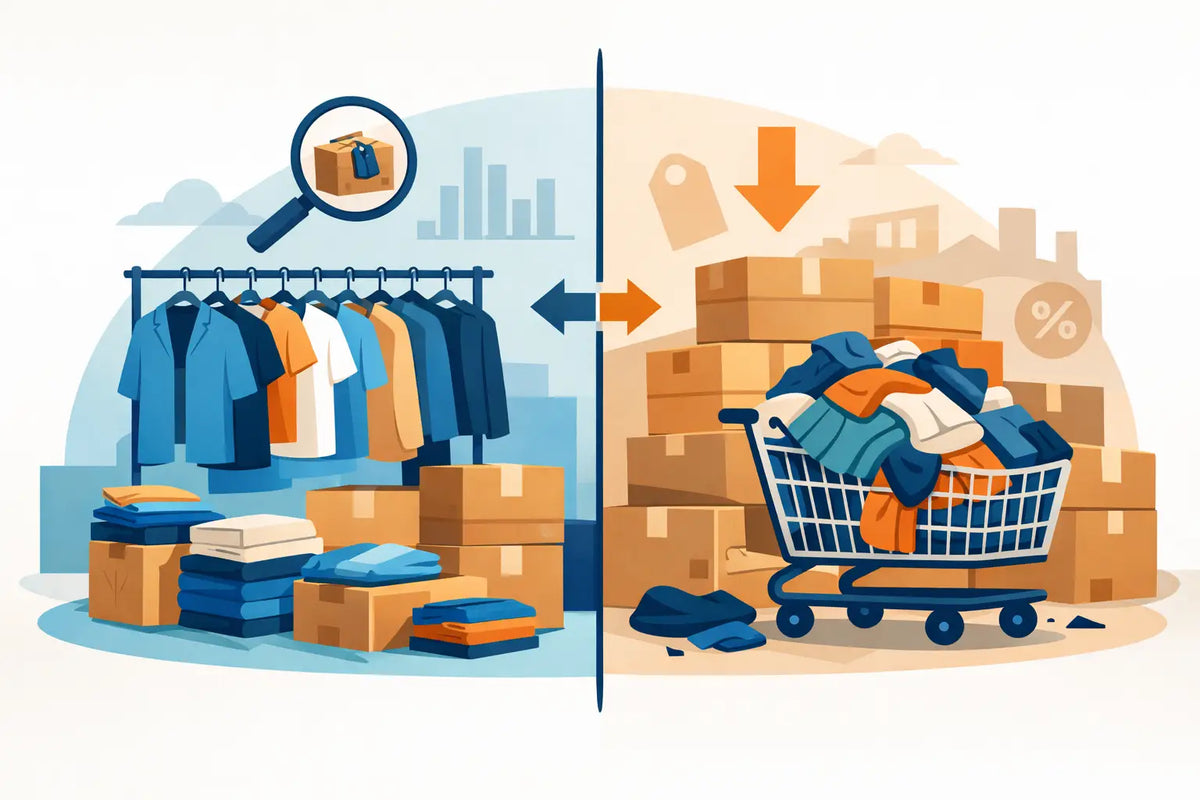
At a practical level, stocklots are usually surplus branded goods that remain available outside the primary retail cycle. That can include overproduction, canceled orders, sample collections, end-of-season stock, or leftover inventory from brand and retail channels. The key point is that the goods are still part of an organized commercial flow. They are often packed and sold as wholesale lots with a defined category, quantity range, season, or brand profile.
Liquidation apparel is broader and often less controlled. It usually comes from business closeouts, distressed inventory sales, retailer failures, warehouse clearances, or forced stock disposal. Some liquidation stock is perfectly resellable, but the source is often more reactive. That means more variation in presentation, sizing consistency, packaging, and product history.
This is why stocklots vs liquidation apparel is really a sourcing strategy question. One channel tends to offer more structure. The other can offer aggressive pricing, but with more uncertainty attached.
Why wholesale buyers separate the two
Experienced buyers separate stocklots from liquidation because the downstream selling job is different. If you operate outlets, off-price stores, export channels, or B2B redistribution, consistency matters. Not perfect consistency, but enough control to build a margin plan.
Stocklots are usually easier to position because they often retain stronger commercial identity. You may be buying leftover branded apparel, shoes, or accessories from known labels with a clearer category structure. That makes it easier to forecast resale pricing and decide whether the lot fits local demand.
Liquidation apparel can still be attractive, especially when you have the warehouse capacity and labor to process mixed goods. But it often requires more sorting, more grading, and more tolerance for unevenness. If your business model depends on speed, that extra handling can reduce the price advantage you thought you were getting.
Product condition and assortment control
One of the biggest differences in stocklots vs liquidation apparel is product condition. Stocklots are commonly expected to arrive in commercially resellable condition, although exact standards vary by supplier and lot type. You may still see broken size curves, partial sets, mixed seasons, or packaging differences, but the goods are typically intended for resale through secondary channels.
With liquidation apparel, the range is wider. One lot may contain clean overstock. Another may include shopworn pieces, older inventory, relabeled items, damaged packaging, or mixed-return influence depending on the source. That does not make liquidation bad. It simply means the buyer needs tighter due diligence and a more realistic margin model.
Assortment control matters just as much. A stocklot may be offered as men’s branded polos, women’s dresses, kidswear, denim, footwear, or accessories with a clearer quantity and category structure. Liquidation lots are more likely to be mixed in ways that create hidden labor costs. If you need to open every carton to build saleable units, your landed cost is not just the invoice price.
Pricing: cheaper is not always better
Many buyers approach liquidation expecting the lowest entry price, and often they are right. On paper, liquidation apparel can look more attractive than stocklots. The problem is that invoice price and resale margin are not the same thing.
Stocklots often trade at higher wholesale prices because the goods are more commercially usable. Better brand recognition, cleaner presentation, and more predictable category makeup can support faster turnover. That matters if your cash cycle depends on moving inventory quickly rather than chasing the absolute lowest buy cost.
Liquidation can outperform stocklots when the buyer has the right setup. If you have sorting staff, flexible sales channels, and buyers for mixed-grade product, lower purchase cost can create excellent margin. But if your model depends on listing branded items quickly, maintaining presentation quality, or selling in markets with stricter customer expectations, the lower upfront cost can disappear fast.
Brand value and resale confidence
In the apparel trade, recognizable labels still move product. Surplus inventory from known fashion brands usually gives buyers a clearer resale story than generic mixed liquidation. That does not guarantee success, but it improves the odds of faster movement and stronger average selling prices.
For many wholesale buyers, stocklots are attractive because they offer access to branded leftover inventory without entering primary distribution channels. That can support off-price retail, export, online resale, and local wholesale redistribution. When the lot includes commercially relevant brands and usable categories, the resale path is easier to map.
Liquidation apparel may include branded goods too, but the branding advantage is often less straightforward. Label consistency may be weaker, seasonality may be harder to manage, and the lot may contain too many low-demand units around the stronger pieces. Buyers need to look past the headline names and ask how much of the lot is truly saleable in their own market.
When stocklots make more sense
Stocklots usually fit buyers who value cleaner execution. If you run an off-price store, outlet, export business, or B2B resale operation and need recognizable product with manageable sorting requirements, stocklots are often the safer commercial choice.
They also suit smaller professional buyers. A private entrepreneur or company account buying individual branded pieces or smaller wholesale packages may not have the warehouse team to process liquidation-grade complexity. In that case, more organized stock is worth paying for because it reduces friction from purchase to resale.
This is especially true when you sell across borders. Export buyers need more than low prices. They need inventory that can be described, packed, priced, and moved with fewer surprises. In those cases, a structured stocklot often supports better business than a cheap mixed liquidation load.
When liquidation apparel can be the better buy
Liquidation apparel makes sense when your operation is built for opportunistic buying. If you can absorb mixed categories, irregular size runs, packaging issues, or variable condition, you can buy low and create value through sorting and channel allocation.
This model suits buyers with multiple exit routes. You may sell the best pieces online, move mid-tier goods to discount stores, and clear lower-value units through bulk channels. If your team knows how to grade and repackage efficiently, liquidation can be highly profitable.
The key is discipline. Buyers get into trouble when they purchase liquidation stock using stocklot assumptions. If you expect neat branded assortments and receive a labor-heavy mixed lot, the problem is not the category. The problem is the buying decision.
Questions to ask before you buy either one
Before committing to stocklots or liquidation apparel, ask how the inventory was created. Was it overproduction, canceled orders, end-of-season surplus, store closure stock, or general clearance? The source tells you a lot about likely consistency.
Then look at how the lot is presented. Are categories defined? Are brands specified? Is the quantity per SKU or size range known, even approximately? Are you buying packed lots, mixed pallets, or individually listed pieces? The more clarity you have, the more accurately you can model your resale margin.
You also need to match the lot to your market. A strong branded surplus package can still fail if the season, category, or price point does not fit local demand. The best buyers do not just ask whether the inventory is cheap. They ask whether it is right.
For buyers working internationally, commercial reliability matters as much as product. A supplier focused on wholesale apparel flow, branded surplus access, and cross-border trade is usually better positioned to support repeat business than a one-off distressed stock source. That is one reason many trade buyers prefer structured stocklots through platforms like Stock IT B2B when they need consistency alongside opportunity.
The better question is not which is best
The better question is which model fits your operation today. Stocklots generally offer more control, stronger resale confidence, and easier stock movement. Liquidation apparel can deliver stronger buying prices, but usually asks more from your warehouse, your team, and your sales channels.
Good buyers do not choose based on category names alone. They choose based on workload, risk tolerance, and resale path. If the inventory arrives and you already know where it will go, how it will be priced, and how quickly it will move, you are buying well. That is the standard worth using on every lot.