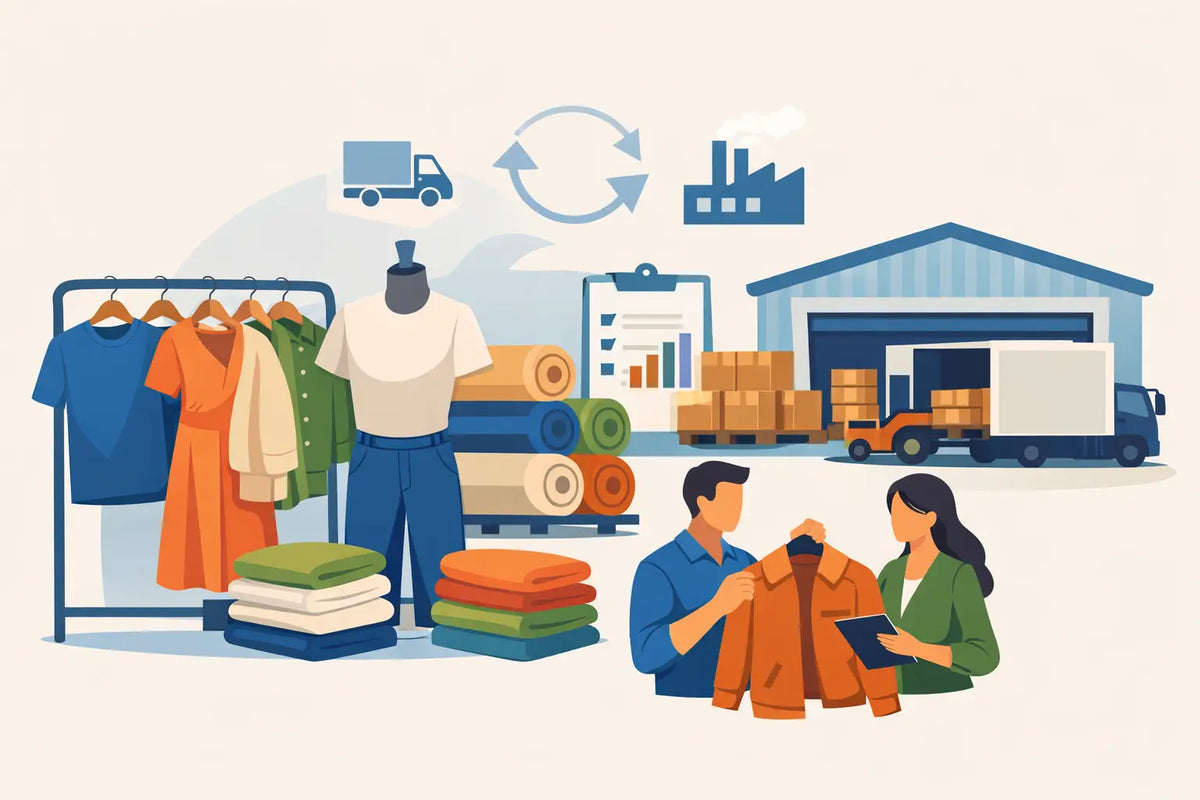
Choosing a Closeout Clothing Wholesale Supplier
One bad stock buy can sit in your warehouse for six months. One good buy can sell through in weeks and finance the next three orders. That is why choosing a closeout clothing wholesale supplier is not a sourcing detail. It is a margin decision, a cash flow decision, and often the difference between clean turnover and dead inventory.
In off-price apparel, the supplier matters as much as the product. Branded stock, leftover collections, overproduction, samples, and mixed surplus lots can all be profitable, but only when the offer matches your channel, your market, and your resale speed. Professional buyers already know that cheap goods are not automatically good goods. The real question is whether the stock can move.
What a closeout clothing wholesale supplier should actually provide
A serious closeout clothing wholesale supplier does more than list discounted apparel. The supplier should provide commercial access to stock that fits resale logic. That means recognizable brands, usable size runs, clear product categories, and enough lot detail to let buyers make decisions quickly.
For an outlet, a discount chain, or an independent reseller, closeout stock works because it creates room between acquisition cost and resale price. That room disappears fast when the goods are poorly sorted, off-season for your market, damaged, or impossible to position. A useful supplier understands this and structures offers around trade reality, not vague promises.
The strongest suppliers also understand cross-border business. If you buy for export, documentation, origin, packing, and destination restrictions matter. If you buy inside the EU or resell into another market, operational clarity matters just as much as price. International apparel sourcing is rarely complicated for experienced buyers, but it becomes expensive when the supplier is disorganized.
Price matters, but turnover matters more
A lot of buyers focus first on the discount level. That is normal, but it is incomplete. A 90 percent markdown on the wrong product is worse than a 65 percent markdown on a lot that sells immediately. In closeout buying, speed of sell-through often matters more than the headline deal.
That is especially true with branded inventory. Labels such as Tommy Hilfiger, C&A, Desigual, Tom Tailor, Gant, U.S. Polo Assn., S.Oliver, Mötivi, or SHEIN may attract attention, but brand name alone does not guarantee performance. Category mix, styling, condition, season, and local demand still decide the outcome.
A practical buyer looks at several things at once: expected resale channel, target customer, average selling price, and how much handling the lot will require. If you need to re-sort heavily, re-tag, or split sizes manually, your true cost is already rising. A better supplier reduces that friction by presenting stock in a way that supports faster buying and faster resale.
How to evaluate a closeout clothing wholesale supplier
The first checkpoint is stock quality. Not luxury positioning, not marketing language, just usable quality. Are the goods authentic? Are they branded as described? Are they stock leftovers, samples, or surplus lots with a clear origin? Trade buyers do not need polished storytelling. They need product truth.
The second checkpoint is lot transparency. You should be able to understand what you are buying before committing serious money. That can mean category breakdowns, photos, labels, brand references, quantity details, and whether the offer is mixed or sorted. Some buyers are comfortable with broad mixed lots. Others need more control. Neither approach is wrong, but the supplier should be clear.
The third checkpoint is buying format. Not every customer needs pallets only. Some businesses need full stocklots by category or brand, while smaller operators may want to buy individual pieces through a B2B account and test a market before scaling. A supplier that supports both bulk buyers and smaller professional buyers is often easier to grow with.
The fourth checkpoint is operational capacity. Can the supplier handle export? Can they support repeat orders? Is the inventory updated often enough to justify checking back? In closeout, one good order is useful. A repeatable flow of opportunities is much more valuable.
Different buyers need different stock structures
A closeout lot that works for an outlet operator may not work for an online reseller. An outlet can absorb broader assortments and build merchandising around mixed branded categories. An e-commerce reseller usually needs more control over item presentation, condition consistency, and unit economics. A wholesaler serving secondary retailers may care more about average margin across the lot than about each single SKU.
This is where many sourcing mistakes happen. Buyers choose based on discount without checking whether the lot structure matches the business model. If you sell through marketplaces, single-piece listings and product-level handling can slow you down. If you run physical stores, a mixed branded lot may create the variety you need. If you export to price-sensitive markets, mass appeal can outperform niche fashion.
The right supplier should not force every buyer into the same format. They should offer stock in ways that make commercial sense for different trade customers.
Branded surplus stock and the real value behind it
Branded closeout apparel stays attractive because it shortens the selling process. Recognizable labels reduce the effort needed to explain the product to the end customer. The buyer sees the brand, understands the value position, and compares the retail price against the off-price ticket. That gap is where the opportunity sits.
Still, branded stock has trade-offs. Some lots are highly commercial and easy to move. Others are more fragmented in sizing, category, or style direction. Buyers who understand their market can still make good money on fragmented lots, but only if the purchase price leaves room for that extra work.
This is why experienced operators do not ask only, “How cheap is it?” They ask, “How fast can I sell it, and in which channel?” A reliable supplier helps answer that through product access and stock clarity, not through exaggerated claims.
Why international capability is a serious advantage
In this segment, local-only sourcing can limit growth. The better buying opportunities often come through international stock movement, especially when the supplier can aggregate surplus branded goods from multiple sources and offer them to trade buyers across countries.
For importers, distributors, and export traders, this matters because stock availability is never perfectly stable. One month may bring stronger opportunities in women’s fashion, another in mixed apparel, shoes, or accessories. A supplier with international setup and regular stock flow gives buyers more room to adjust.
That is also useful for smaller professional buyers. A private entrepreneur with a B2B account may start with individual pieces or a smaller package to test demand. Later, the same buyer may move into stocklots once the sales pattern is clear. Flexible access matters because not every trade customer begins at container level.
Stock IT B2B fits this model by serving professional buyers who need access to branded surplus inventory for both export and EU sales, whether they are sourcing full lots or testing smaller-volume purchases through a B2B account.
Signs you have found the right supplier
The right supplier makes repeat buying easier, not harder. Their offers are commercially readable. Their stock is aligned with real resale channels. Their process supports account-based B2B purchasing instead of retail-style browsing. Most importantly, they understand that professional buyers measure success by margin, turnover, and continuity.
That does not mean every lot will be perfect. Closeout buying always involves variance. Size imbalance, seasonal timing, and category mix are part of the business. What matters is whether the supplier helps you evaluate that variance properly before you buy.
Good closeout suppliers also respect speed. Buyers do not want long explanations. They want current stock, clear terms, and the ability to move when the lot is right. If the supplier can deliver that consistently, they become more than a source of discounted apparel. They become part of your buying system.
If you are evaluating your next closeout clothing wholesale supplier, focus less on the loudest discount and more on the stock you can actually turn. The best deals are not the cheapest on paper. They are the ones that leave your warehouse again, quickly and profitably.