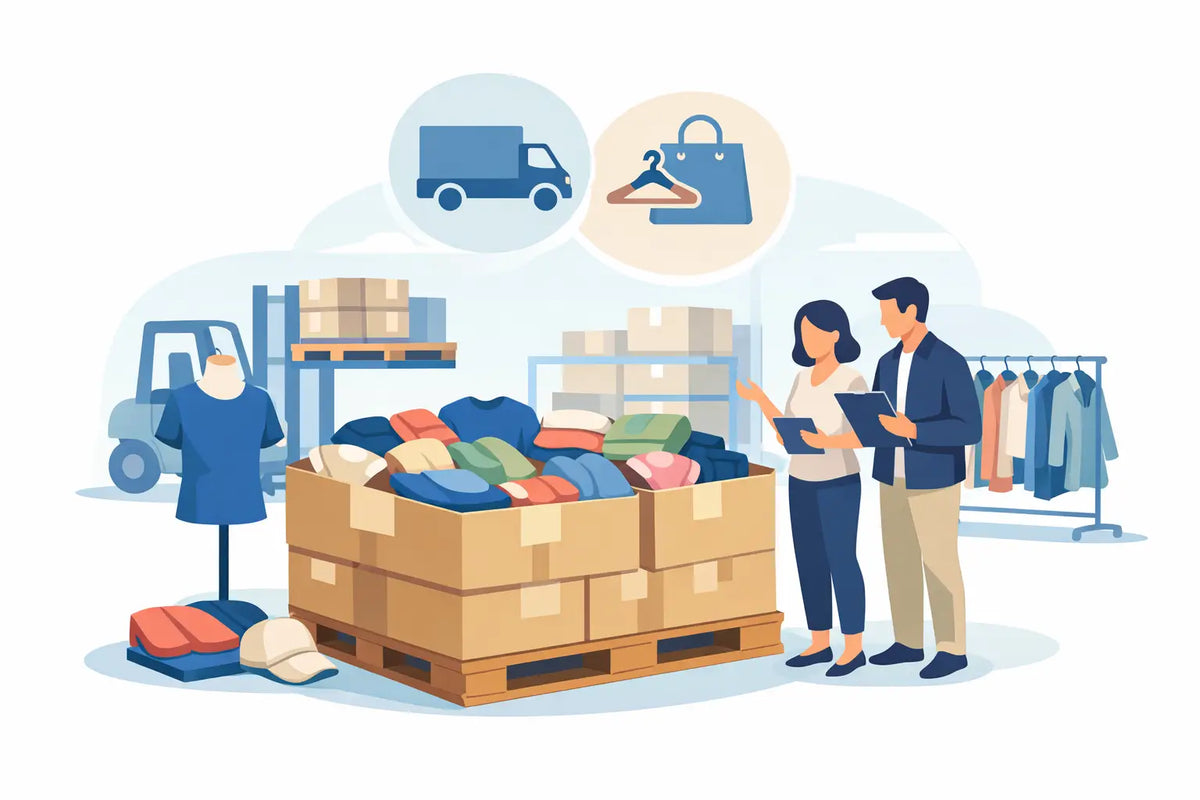
Buying Wholesale Clothing Lots by Pallet
A pallet can solve a stock problem fast - or create one just as fast. That is why professional buyers do not look at wholesale clothing lots by pallet as a simple volume deal. They look at brand mix, sell-through potential, carton structure, export terms, and whether the stock can move in their market without sitting too long.
For off-price stores, outlet operators, online resellers, and import-export traders, pallet buying sits in a useful middle ground. It offers more scale than piece-by-piece buying, but it is still more flexible than taking a full truckload or container. If you buy well, pallets let you test brands, refill categories, and react to demand without overcommitting cash.
Why wholesale clothing lots by pallet work for trade buyers
The main advantage is efficiency. A pallet format gives buyers enough quantity to matter, while keeping handling and purchasing manageable. Instead of negotiating many small packs, you secure a consolidated stocklot that is easier to quote, transport, receive, and break down.
This matters most when you are dealing with surplus inventory, leftover branded clothing, sample collections, and end-of-line assortments. In those channels, availability changes quickly. Buyers who wait too long for a perfect breakdown often lose the opportunity. A pallet lets you move fast and still buy at a scale that protects margin.
There is also a commercial advantage. Recognizable labels tend to convert better than unbranded stock, especially in discount retail and online marketplaces. When a pallet includes known fashion brands, the value is not just in cost per unit. It is in faster customer decision-making, stronger merchandising, and better price perception at retail.
That said, pallet buying is not automatically the cheapest route on a per-piece basis. Sometimes mixed pallets include broader size curves, more category variation, or less precise sorting than a hand-picked lot. The right choice depends on how your business sells. If your operation is built around speed and opportunistic buying, pallets often make sense. If you need exact SKU-level planning, they may need more review.
What to check before buying a pallet
A pallet should never be judged by price alone. The first issue is stock composition. Ask what categories are included, whether the lot is men’s, women’s, kids’, or mixed, and whether the assortment is seasonal or trans-seasonal. A cheap summer-heavy pallet bought in late fall may not be cheap once it starts aging in your warehouse.
Next comes brand relevance. Not every label performs equally in every country or channel. Tommy Hilfiger may move well in one retail environment, while a younger online audience may respond faster to trend-led names such as SHEIN. C&A, Tom Tailor, Gant, S.Oliver, U.S. Polo Assn., Desigual, or Mötivi may each perform differently depending on your customer base, price architecture, and region. Experienced buyers match brand recognition to local demand instead of assuming every branded piece has the same resale value.
Condition is another basic control point. In stock apparel, you need clarity on whether goods are from overstock, canceled orders, sample runs, or store returns. These are not the same. Clean surplus stock with labels and standard packing is one thing. Mixed-return goods are another. Both can have a market, but they belong in different pricing structures.
Carton count and estimated units per pallet also matter. A pallet described only as a “mixed branded clothing lot” is not enough for serious buying. You need to understand the approximate piece count, category split, and whether assortments are random or partly sorted. The more transparent the stock data, the easier it is to calculate margin.
How to evaluate pricing without guessing
In pallet buying, the wrong calculation is focusing only on the headline pallet price. The correct calculation starts with expected resale performance. You want to know your landed cost per piece, then compare that with realistic selling prices in your channel.
For example, a pallet of branded apparel with a slightly higher entry price may still outperform a cheaper lot if the brands sell faster and require less discounting. Margin is not just what you buy at. It is what you recover after storage, markdowns, labor, shipping, and dead stock.
This is why mixed lots need careful reading. A pallet with strong labels can still underperform if size balance is weak or if too many pieces fall into slow categories. A better pallet is often the one with a more practical assortment, not the one with the biggest theoretical retail value.
Professional buyers also separate gross margin from cash flow value. If a pallet turns in three weeks, that can be better than a slower pallet with a slightly higher markup. In off-price and secondary distribution, speed is part of profitability.
Wholesale clothing lots by pallet and logistics
Logistics are part of the buying decision, not something to think about later. Pallet dimensions, total weight, warehouse handling, and shipping terms all affect your cost. This is especially true for buyers working across borders, where customs, export documentation, VAT treatment, and carrier coordination can change the real economics of a deal.
If you are buying inside the EU for local resale, your process may be straightforward. If you are exporting outside the EU, product eligibility and paperwork become more important. Some branded stock can be sold internationally under specific trade conditions, and some lots may have distribution restrictions. Clear commercial information upfront saves time and prevents disputes later.
Buyers should also think about pallet efficiency after arrival. Can your team process the goods quickly? Will you need to re-sort by gender, size, or category before resale? A pallet that is easy to unload but slow to prepare for market may cost more than expected in labor.
Who benefits most from pallet buying
Pallet lots are a strong fit for several buyer profiles, but not for the same reason.
Off-price retailers use them to refresh floor stock quickly and keep branded product on offer without committing to full seasonal programs. Outlet operators use them to widen assortment and maintain value perception. Online resellers use pallets to source branded inventory with enough depth to build campaigns, bundles, or repeat listings.
Import-export traders often value pallet buying for a different reason: flexibility. They can test a market, combine categories, or move mixed branded stock across different customer groups without taking container-level risk.
Smaller buyers can also benefit. A private entrepreneur or registered company with a B2B account may start with individual pieces or smaller packages, then step into pallet buying once demand is proven. That progression makes sense. Not every business needs to begin with the biggest possible volume. What matters is buying at the level your turnover can support.
Common mistakes buyers make with pallet stock
The first mistake is buying based on brand name alone. A recognized label helps, but it does not replace basic assortment discipline. A pallet still needs workable sizes, useful categories, and a price that leaves room for your channel.
The second is ignoring market fit. A buyer may know a brand is strong in one country and assume it will perform the same way elsewhere. In practice, price sensitivity, customer age, seasonality, and local competition all shape sell-through.
The third is underestimating handling time. Mixed pallets can be commercially attractive, but they may require sorting, relabeling, photography, or repacking. If your model depends on fast turnover, operational friction matters.
The last mistake is waiting for a perfect lot. In surplus and leftover branded apparel, stock availability is dynamic. Good opportunities do not stay open long. The better approach is to know your numbers in advance, set buying criteria, and move quickly when a pallet fits.
How experienced buyers source better pallet deals
Strong buyers are consistent. They know which brands work, what landed cost they can tolerate, which categories turn fastest, and how much stock their warehouse can absorb. Because of that, they can judge a pallet in minutes, not days.
They also favor suppliers that understand B2B trading rather than consumer retail. In this segment, clear stock descriptions, account-based access, international sales capability, and regular availability matter more than polished storytelling. A supplier such as Stock IT B2B is built around that logic - branded surplus apparel, shoes, and accessories offered in wholesale formats for professional buyers who need stock movement, not retail marketing.
The real value of wholesale clothing lots by pallet is not volume by itself. It is controlled access to branded inventory in a format that supports margin, speed, and operational flexibility. Buy with discipline, and pallets can become one of the most practical tools in your sourcing mix. Buy without a plan, and they become expensive storage. The difference usually comes down to one thing: knowing exactly how the stock will move before it ever reaches your floor or warehouse.